 Independent Research Guide
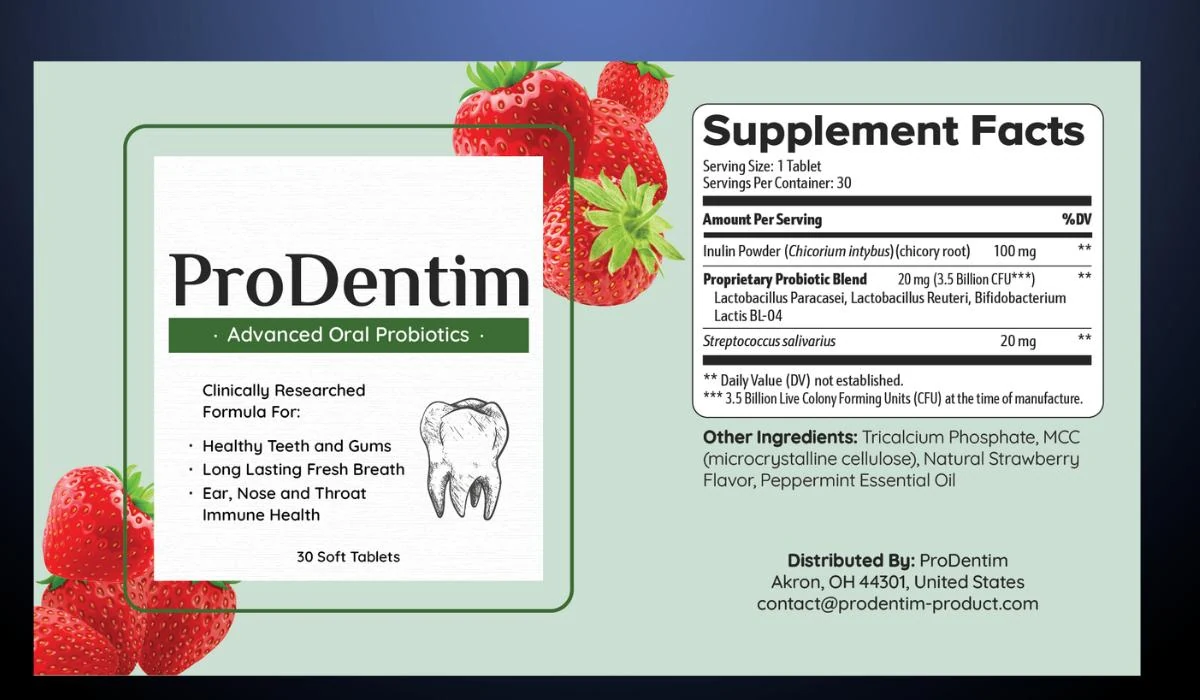
Current ProDentim ingredient list from the supplied label
For this site, the supplied Supplement Facts panel is the primary source for what is inside the current bottle. It is more authoritative for formula statements than older affiliate pages, promotional illustrations or ingredient lists copied from search results.
| Label item | Amount per serving | What the label discloses |
|---|---|---|
| Inulin Powder (Cichorium intybus), chicory root | 100 mg | Quantified separately |
| Proprietary Probiotic Blend | 20 mg | 3.5 Billion CFU at time of manufacture; contains L. paracasei, L. reuteri, B. lactis BL-04 |
| Streptococcus salivarius | 20 mg | Listed separately; no strain designation shown on supplied panel |
What is in the proprietary probiotic blend?
The label names three organisms inside the 20 mg proprietary probiotic blend: Lactobacillus paracasei, Lactobacillus reuteri and Bifidobacterium lactis BL-04. It describes the blend as providing 3.5 billion live colony forming units (CFU) at the time of manufacture.
“At the time of manufacture” is also a meaningful qualifier. It is not the same wording as a guaranteed CFU count through the end of shelf life.
L. paracasei
Human oral-health research exists for specific L. paracasei strains, but strain identity and study design matter.
L. reuteri
L. reuteri has been studied in periodontal and oral-health contexts; evidence cannot be generalized automatically to every formulation.
B. lactis BL-04
BL-04 is the strain designation shown on the current label. Research on another B. lactis strain is not direct evidence for BL-04.
Streptococcus salivarius: separately listed at 20 mg
The supplied panel lists Streptococcus salivarius at 20 mg outside the proprietary probiotic blend. It does not show a strain designation such as K12 on the supplied image.
This distinction is important because published studies often test specifically identified strains. A study of S. salivarius K12, for example, should not be presented as though the current ProDentim label confirms K12. Our S. salivarius guide separates species-level label information from strain-specific research.
Inulin powder: 100 mg from chicory root
Inulin is a fermentable carbohydrate commonly described as a prebiotic because certain microorganisms can use it as a substrate. The label identifies the source as chicory root and quantifies it at 100 mg per serving.
The presence of inulin can help explain why the vendor describes ProDentim as a probiotic-plus-nutrient formula, but that does not establish a dental outcome. Broader prebiotic biology and finished-product effectiveness are different questions. See Inulin, Prebiotics and Oral Health.
Other ingredients on the supplied label
The current panel lists tricalcium phosphate, microcrystalline cellulose (MCC), natural strawberry flavor and peppermint essential oil under “Other Ingredients.” These may contribute to tablet structure, flavor or formulation rather than functioning as the named probiotic blend.
Related reading: Tricalcium Phosphate in Dental Products and Peppermint Essential Oil in Oral Care.
How to read ProDentim ingredient research without overclaiming
A scientifically responsible ingredient analysis asks whether the published study used the same species or strain, a comparable dose, a similar delivery form, a relevant population and a meaningful outcome. Even when all of those align, research on one ingredient does not automatically validate the finished multi-ingredient product.
- Label fact: what the bottle says is present.
- Vendor claim: how the seller describes a product or ingredient.
- Independent evidence: what a study or professional source reports under its own conditions.
- Finished-product evidence: research that directly tests the actual marketed formulation.
Our site does not collapse these categories into one. For a wider evidence review, see Probiotics and Oral Health: What Human Research Shows.
Independent research examples
- Randomized research involving a specific Lactobacillus paracasei strain.
- Bifidobacterium lactis HN019 periodontal randomized trial — HN019 is not BL-04, so it is not direct evidence for the label strain.
- Streptococcus salivarius K12 randomized halitosis study — the supplied ProDentim label does not identify K12.